
OUR REFUSAL TO COMMODIFY THE GOSPEL
Luke’s has been my favorite gospel account for as long as I remember being familiar enough with the four of them to have a favorite one. He meticulously included a myriad of details unique to his collection of events, all of which provide additional color when held against familiar moments. For example, Matthew, Mark, Luke, and John all include Peter’s infamous denial of Jesus during His arrest, but only Luke tells us that as Jesus’ word concerning the third denial coinciding with the rooster crowing came to pass, Jesus looked directly at Peter as he fled in bitter tears.[1] It is a tender, bittersweet illumination of Jesus in that particular and very stressful moment.
But long before that fateful night, Jesus developed Peter and the others into mature ministry leaders (minus Judas Iscariot). As they traveled throughout Israel, many flocked to see them, hear Jesus’ teaching, and perhaps benefit from His miracles.[2] Several endeavored to join them; many were refused. Luke included a sequence of three just before he described the seventy-two being sent out (another event unique to his account):
As they were going along the road, someone said to Him, “I will follow you wherever You go.” And Jesus said to him, “Foxes have holes, and birds of the air have nests, but the Son of Man has nowhere to lay His head.” To another He said, “Follow Me.” But he said, “Lord, let me first go and bury my father.” And Jesus said to him, “Leave the dead to bury their own dead. But as for you, go and proclaim the Kingdom of God.” Yet another said, “I will follow You, Lord, but let me first say farewell to those at my home.” Jesus said to him, “No one who puts his hand to the plow and looks back is fit for the Kingdom of God.”[3]
These are jarring, sobering conversations. Jesus makes it clear He is all-or-nothing. Immediately after these conversations, Luke described Jesus sending seventy-two in teams of two “into every city and place where He Himself was about to go.”[4] This is a chapter after the core twelve were first sent under similar circumstances, which is at the start of Luke 9 and included elsewhere in Mark and Matthew’s gospel accounts as well.[5] Both with the twelve and the seventy-two, Jesus instructed them to head out empty-handed, save a staff (which served practical purposes; some of the terrain is quite rugged). All writers include some variation of these words, with Luke quoted here:
And He called the twelve together and gave them power and authority over all demons and to cure diseases, and He sent them out to proclaim the Kingdom of God and to heal. And He said to them, “Take nothing for your journey, no staff, nor bag, nor bread, nor money; and do not have two tunics. And whatever house you enter, stay there, and from there depart. And wherever they do not receive you, when you leave that town shake off the dust from your feet as a testimony against them.” And they departed and went through the villages, preaching the Gospel and healing everywhere.[6]
Imagine the privilege of being part of Jesus’ ministry team, and the excitement to hear you were being entrusted with an unsupervised ministry trip. Perhaps you’d feel some anxiety in the uncertainty, the allure of a new experience. You start thinking through what you’d pack to be efficient and nimble—and then you hear, “Nothing. You pack nothing.” What? “You’re at the mercy of the folks receiving you.” No writer records even Peter interrupting to ask questions this time. I imagine a gleam in Jesus’ eyes, winking, “Trust Me.” What a journey.
So the twelve leave and return, exuberant as they recounted their escapades and the power of God that bore witness to the Word they carried. Then several try to join Him, of which Luke records the three conversations this article opened with. Several introduced themselves with some kind of, “I’m in, but…” which Jesus unequivocally refused. But He built a team of seventy-two and sent them out with the same instructions the twelve had received, but Luke here includes two additions:
After this the Lord appointed seventy-two others and sent them on ahead of Him, two by two, into every town and place where He Himself was about to go. And He said to them, “The harvest is plentiful, but the laborers are few. Therefore pray earnestly to the Lord of the harvest to send out laborers into His harvest. Go your way; behold, I am sending you out as lambs in the midst of wolves. Carry no moneybag, no knapsack, no sandals, and greet no one on the road. Whatever house you enter, first say, ‘Peace be to this house!’ And if a son of peace is there, your peace will rest upon him. But if not, it will return to you. And remain in the same house, eating and drinking what they provide, for the laborer deserves his wages. Do not go from house to house. Whenever you enter a town and they receive you, eat what is set before you. Heal the sick in it and say to them, ‘The Kingdom of God has come near to you.’ But whenever you enter a town and they do not receive you, go into its streets and say, ‘Even the dust of your town that clings to our feet we wipe off against you. Nevertheless know this, that the Kingdom of God has come near.’ I tell you, it will be more bearable on that day for Sodom than for that town.[7]
“Greet no one on the road” is unique here; it’s possible Jesus didn’t want the broader teams of new recruits to get distracted or talk themselves out of the assignment. But this second element is shared in Luke’s account of the seventy-two, and Matthew’s account of the twelve being sent out: A laborer is worth his wages. As they were sent empty-handed, they would be supported on the journey by those who received the urgent witness Gospel of the Kingdom carried by Jesus’ ministry teams. Now, I have spent more than a thousand words belaboring these accounts to demonstrate the origin of this phrase. We quote it now a lot with what I believe to be distortions, which I will explain in a moment. When we quote this principle, we are often quoting Paul to Timothy, as the aged apostle closed his first letter to his protégé and spiritual son with instructions for stewardship of resources for widows and elders:
Let the elders who rule well be considered worthy of double honor, especially those who labor in preaching and teaching. For the Scripture says, “You shall not muzzle an ox when it treads out the grain,” and, “The laborer deserves his wages.”[8]
Paul, as he often did, relied on the Torah and Tanakh as he wrote his own epistles. He here quotes a principle in Deuteronomy to not unjustly impede a worker’s ability to nourish themselves (as well as just being humane stewards of literal livestock). Similarly, Jesus may have been loosely paraphrasing a Levitical law to not defraud or withhold the wages of a day laborer overnight (see Leviticus 19:13). These are laws preventing oppression, manipulation, and abuse. Jesus’ commission to the ministry teams of two to receive material support as they traveled kept the work honest, as these individuals were sent as empty-handed volunteers.
But it is important to note that at no point was the Gospel ever put behind a paywall. And sometimes, when we quote Paul’s use of this phrase, we’re doing so to excuse the fact that we’re putting the Gospel behind a paywall.
Jesus did not allow His disciples to charge entrance for events. Those who heard the message were not obliged to tip the disciples. They neither worked on commission. And Paul never sold his letters to his recipients. All of these men abided by Jesus’ words as He sent the twelve to begin with: “You received without pay; give without pay.”[9] Other translations render “freely you received, freely you shall give.” Consider Jesus’ explicit instructions to the twelve as Matthew rendered them:
…Proclaim as you go, saying, ‘The Kingdom of heaven is at hand.’ Heal the sick, raise the dead, cleanse lepers, cast out demons. You received without paying; give without pay. Acquire no gold or silver or copper for your belts, no bag for your journey, or two tunics or sandals or a staff, for the laborer deserves his food. And whatever town or village you enter, find out who is worthy in it and stay there until you depart. As you enter the house, greet it. And if the house is worthy, let your peace come upon it, but if it is not worthy, let your peace return to you. And if anyone will not receive you or listen to your words, shake off the dust from your feet when you leave that house or town. [10]
Speaking frankly, the Western Church has perverted these principles to commodify the Gospel and excuse our behavior when we do. While we have not permitted selling tickets to access a church service, we sell everything else as if it is any other product on the market. Books. Films. Resources. I want to be clear: there are exceptions to this, and I’m grateful for them. But we’ve still allowed a “Christian media industry” to emerge over the last fifty years, and merge with the same worldly markets. A music industry just like any other, selling songs that labels engineer to make the most money. Therefore the Church on the whole is singing songs based on whatever sells, rather than psalms, hymns, and spiritual songs that will teach and admonish us in all wisdom and lead us to fellowship with the Holy Spirit, as Paul himself instructed, that we would walk in wisdom with sober understanding of the hour we live in.[11] Yet we are not mature in our understanding. It is no wonder! We’ve built a book industry just like any other, selling copies that publishers expect will make the most money. It is no wonder our general messaging is a market saturated with biblically illiterate self-help gurus who cherry-pick Bible verses to ostensibly sanctify their message. We are a people, however sincere, of inch-deep theology and youth group faith, ill-equipped to endure to the end of this age. Everyone praises the memory of Keith Green, but no one is willing to walk the path he walked. It’s easy to speak highly of someone who confronted the impurity of a toxic system when they’re no longer around to confront us—or confront the fact that we’re still building an impure system to begin with. Now, we think it is normal for a Bible teacher to receive freely from the Lord and then sell it on the market. After all, how else will a laborer receive his wages? But that’s not a model that Jesus or Paul put forth.
Before you accuse me of being an anti-capitalist, I’ll say this: Tradition holds that Jesus worked as a carpenter, apprenticed by his earthly father Joseph. There is no evidence to suggest that either man did so for free, save for possible self-appointed measures of generosity. But marketable carpentry and labor are not the same as preaching the Gospel and making disciples. Paul made tents sometimes to make ends meet because he refused to commodify the Gospel.[12] He did not charge at the door as he served from synagogue to synagogue. I’m sure he understood how the basic principles of supply and demand would too easily subject the Gospel of the Kingdom to the whims and wants of the “itching ears” he warned against.[13]
It is not that everyone locking teaching and edification of the Body behind a paywall is a wolf seeking to devour. Many are just doing the done thing because it’s normal in the world we live in. But we are in the world, not of the world,[14] and our stewardship of the Gospel of the Kingdom must prioritize fidelity to the message and free distribution to everyone everywhere. Anything less than this is not faithful to the instruction of Jesus, and it is not faithful to the instruction of the apostles. “Imitate me as I imitate Jesus,” said Paul.[15] So we shall.
The twelve and seventy-two sent on ministry commissions under the leadership of Jesus were not the last to receive such orders. The Body of Jesus was commissioned to “go ye therefore,” to reach every “tongue, tribe, and nation” from Jerusalem to the ends of the earth, “teaching them to obey all” Jesus’ commands, which ultimately is to lead them into all-in love and allegiance to the King of the Jews.[16]
In the last twenty years, the internet has forced the hand of decentralized media distribution. It is my conviction that the Lord has either caused or allowed this for the expedited global reach of the Gospel of the Kingdom. The last decade alone has seen the rise of global platforms like YouTube and Spotify putting access to widely distributed media in the pockets of people everywhere. The internet may be the single greatest gift to the Great Commission in the two thousands years we’ve been entrusted with it. I’d rank airplanes at a close second.
We have an incredible opportunity before us. THE EMMAUS TABLE was developed to function in this mandate without the paywalls, memberships, subscriptions, and sales fees preventing the full reach of the Gospel of the Kingdom worldwide. We are leveraging the internet to get the Gospel of the Kingdom to everyone everywhere, and not limit it to those in the West who can pay for a subscription. We must repent of allowing the monetization of the message to shape the message itself. We must prioritize disciple-making rather than profit margins, and build new models of resource production and distribution that allows for fidelity to the message delivered by Jesus through the prophets and the apostles once and for all.[17] By no means would we suggest internet resources replace face-to-face interpersonal discipleship. But perhaps it can function as a “go-before,” something as those ministry teams of twelve and seventy-two did so long ago.
Using the model put forth by Jesus and Paul, we raise support for this ministry, which allows for the production, distribution, and translation of a growing resource library to be made available to anyone anywhere with internet. There is no profit margin. There is no ROI burden influencing the message. It’s just the Gospel of the Kingdom, with a model that affords us the freedom to address unpopular and neglected passages of Scripture, like the prophets. Any royalties or revenue naturally generated through streaming on YouTube, Spotify, or the like are deposited straight back into the ministry account to further more translation and distribution of more productions. More Bible studies. More films and documentaries like Covenant and Controversy and Born for War. More projects from THE WIRE. More publishing under THE INKWELL. More original music to encourage, equip, and mature the Body of Jesus before He returns—and we’ll never put our chord charts behind a pay wall or collect CCLI from churches choosing to sing these songs. There will never be a paywall. There will never be a locked door granting access only to paying customers. The message is freely received, and it will be freely given to everyone everywhere.
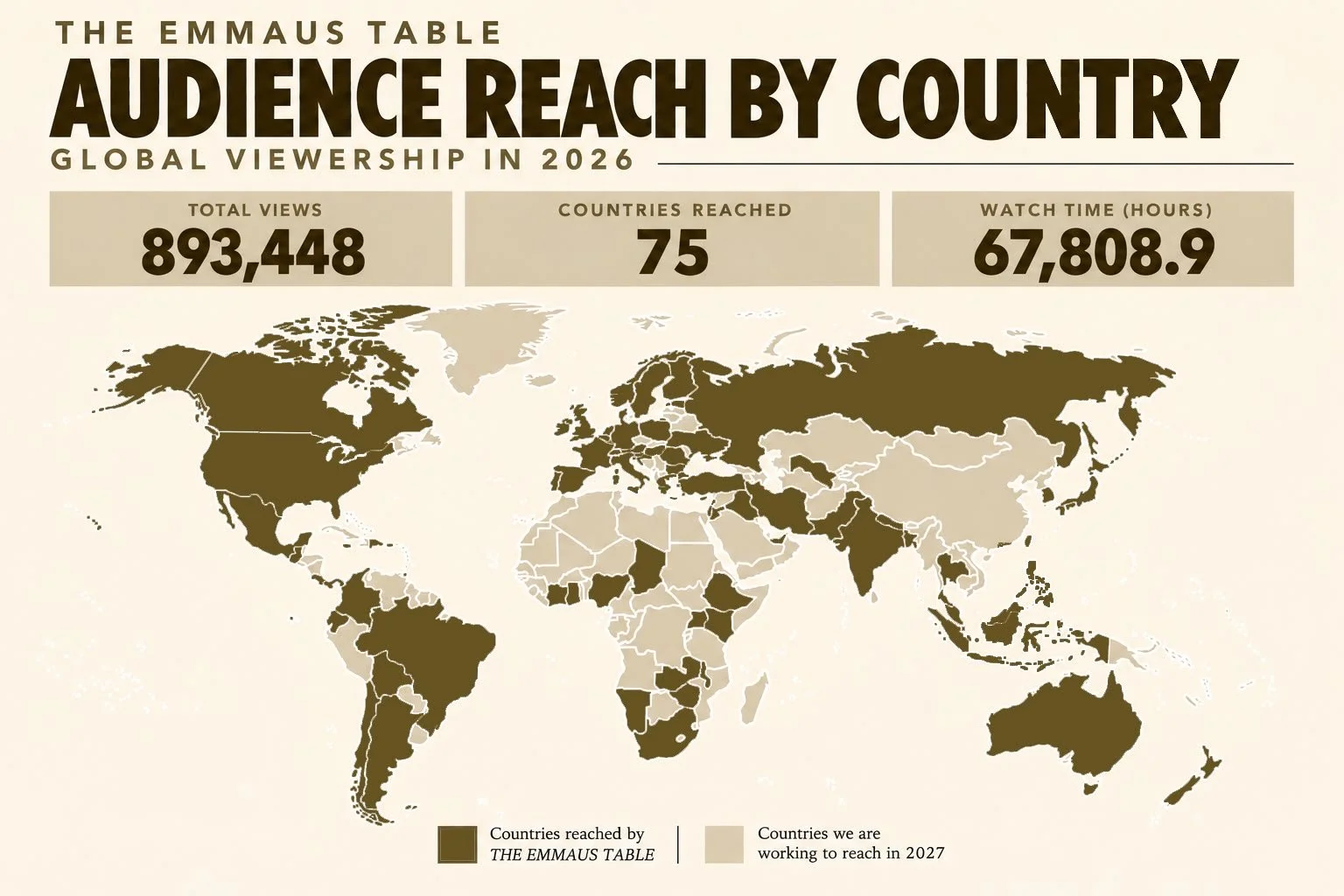
Our ambition is to help people who love Jesus get clarity on the full testimony of Scripture and, much like the disciples who walked with Jesus on the road to Emmaus,[18] bear witness with a burning heart. Below is a graphic showing the reach of our YouTube channel alone in 2026, and you can see we have work to do in the Middle East and Muslim world. If this sounds like something that will serve you, here are three ways to pull up a proverbial chair at THE EMMAUS TABLE:
MARANATHA.
[1] See Luke 22:61-62
[2] See Matthew 4:23; 8:16-17; 15:30; Mark 1:32-34; Luke 4:40; 6:19
[3] Luke 9:57-62; ESV
[4] Luke 10:1, NKJV
[5] See Matthew 10:1-42; Mark 6:7-13; Luke 9:1-6
[6] Luke 9:1-6, ESV
[7] Luke 10:1-12, ESV
[8] 1 Timothy 5:17-18, ESV
[9] Matthew 10:8, ESV
[10] Matthew 10:8-14, ESV
[11] See Ephesians 5:15-21; Colossians 3:12-17
[12] See Acts 18:2-3; 1 Corinthians 9
[13] See 2 Timothy 4:3
[14] See John 17:14-16; 15:19; 18:36
[15] 1 Corinthians 11:1
[16] See Matthew 24:14; 26:13; 28:18-20; Acts 1:6-8
[17] See Galatians 1:6-9; Ephesians 4:4-5; Jude 1:3
[18] See Luke 24:13-35
Stephanie Quick (@quicklikesand) is the founder and creative director of The Emmaus Table. She lives in the Golan Heights and hosts the TABLE TALKS podcast. Browse her free music, films, and books in THE EMMAUS TABLE App and at stephaniequick.org.